Overview
Invoices are how you bill your clients in Beeswax. Most invoices belong to a project and are allocated to a client business, though you can also record General Income that isn't tied to any project (see below). Invoices track money owed to you — the amounts your clients need to pay for work completed.
Every invoice has a unique sequential number generated automatically by the system. You can customise the number if needed.
Invoices follow a workflow from creation through to payment:
- Create the invoice and add line items
- Finalise to lock it for sending
- Send the PDF to your client via email or mark as sent
- Track payments until the invoice is fully paid
Invoices can also be created from templates, duplicated from existing invoices, generated from completed time entries, or converted from approved quotes.
Creating an Invoice
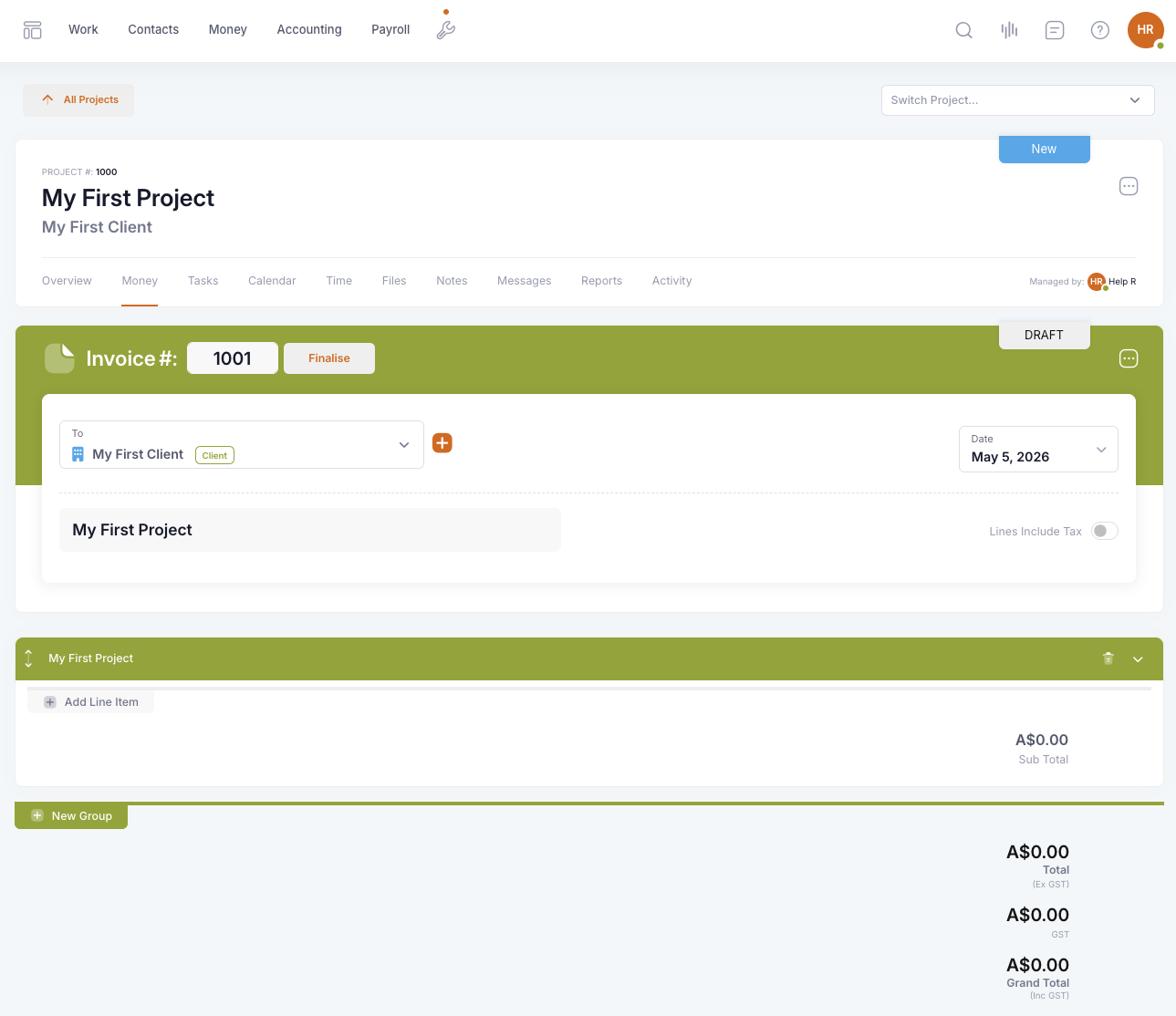
Open a project, select the Money tab, open Invoices, then click New Invoice. Beeswax immediately creates a Draft invoice and opens the invoice page so you can edit it inline.
Fields
| Field | Required | Description |
|---|---|---|
| Invoice # | Yes | Auto-generated sequential number. Can be edited while the invoice is in Draft. |
| To | Yes | The client business or person this invoice is for. Start typing to autocomplete from your contacts. |
| Date | Yes | The invoice date (defaults to today) |
| Title | Yes | A short description of what the invoice is for. The field placeholder is Enter a Title. |
| Lines Include Tax | No | Toggle whether line item amounts already include tax or are tax-exclusive |
| Online Payment | No | Toggle whether the invoice email includes a Review and pay link so your client can pay online by card. Available once Stripe is connected — see the Online Invoice Payments help article. |
| Group Name | No | The section name for a group of line items. The first group is created automatically. |
| Notes | No | Additional notes that appear on exported and emailed PDFs |
| Footnote | No | Fine print displayed at the bottom of exported and emailed PDFs |
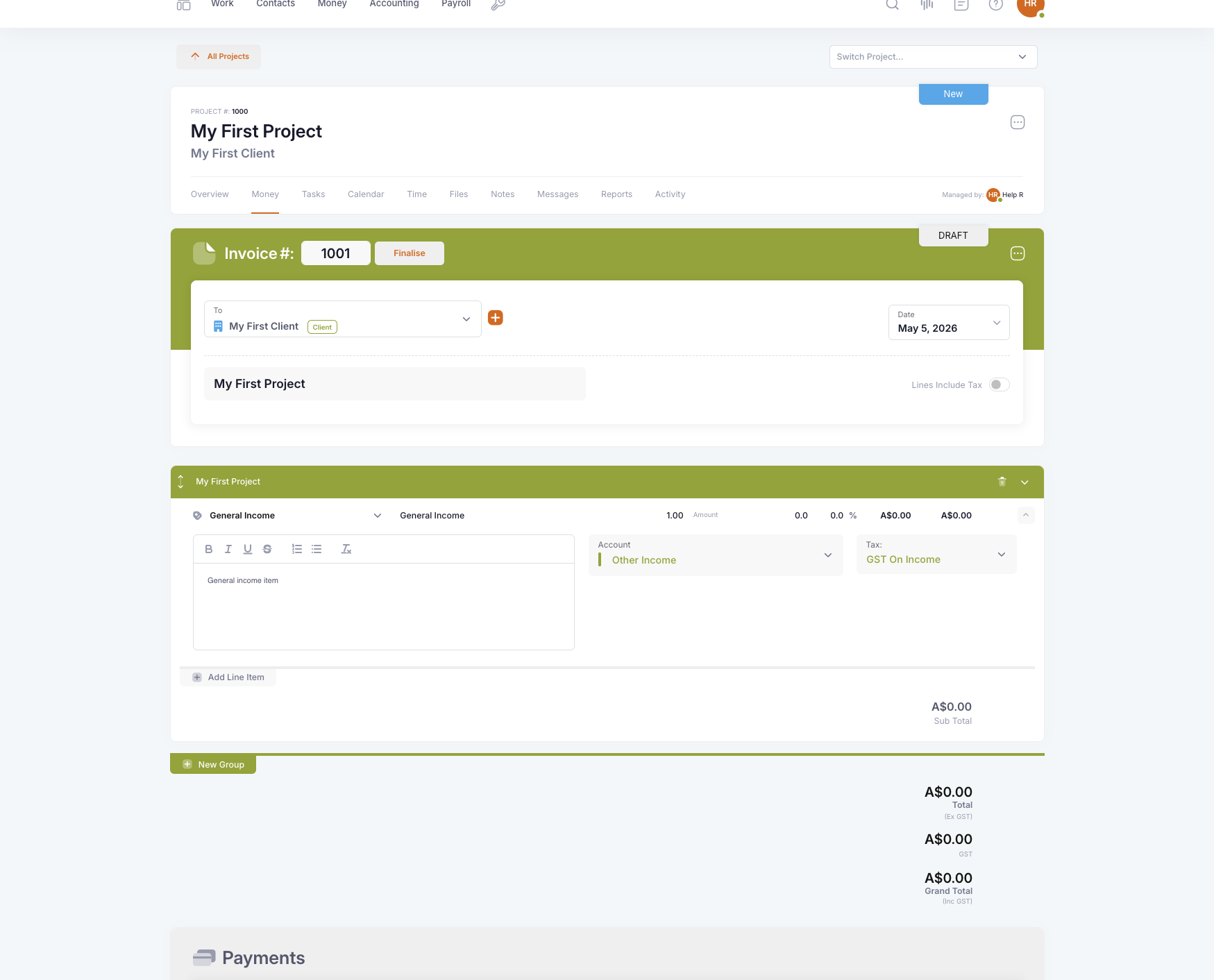
| Account | No | The income account category for a line item, shown when the line item details are expanded |
| Tax: | No | The tax rate for a line item, shown when the line item details are expanded |
Creation Options
- From Time Entries — When creating a new invoice, you can import completed time entries from the project as line items
- From Template — Use the invoice menu and select Templates > Import Template to pre-populate the invoice with predefined line items and settings
- From Quote — Approved quotes can be converted to invoices (see Converting from Quote)
General Income (No Project)
Not all income belongs to a client project. Things like bank interest, rebates, government payments, or one-off sales can be recorded as General Income — an invoice that lives in a built-in area instead of a project, just like Operating Expenses on the expense side.
Creating a General Income Invoice
From the Create New (+) menu in the header, choose Invoice, then pick General Income at the top of the project list — the same way you create an Operating Expense.
Beeswax creates a draft invoice titled "General Income" and opens it for editing. From there it works exactly like any other invoice — set the payer, add line items with the right income account categories, finalise, and record payments against it.
Where General Income Appears
- On the All Income page, general income invoices show a green General Income label instead of a project name, and you can filter to just general income using the project filter
- On the invoice itself, a green General Income ribbon replaces the usual project context
- In your Profit & Loss and other reports, the income appears under whichever income account categories you allocate the line items to — same as project invoices
General Income vs Project Invoices
| General Income | Project Invoices | |
|---|---|---|
| Purpose | Interest, rebates, other non-project income | Billing clients for project work |
| Location | All Income page | Within a specific project |
| Reporting | Appears in overall P&L | Appears in project-level reports too |
| Assignment | Not tied to a client project | Assigned to a named project |
Line Items & Transaction Groups
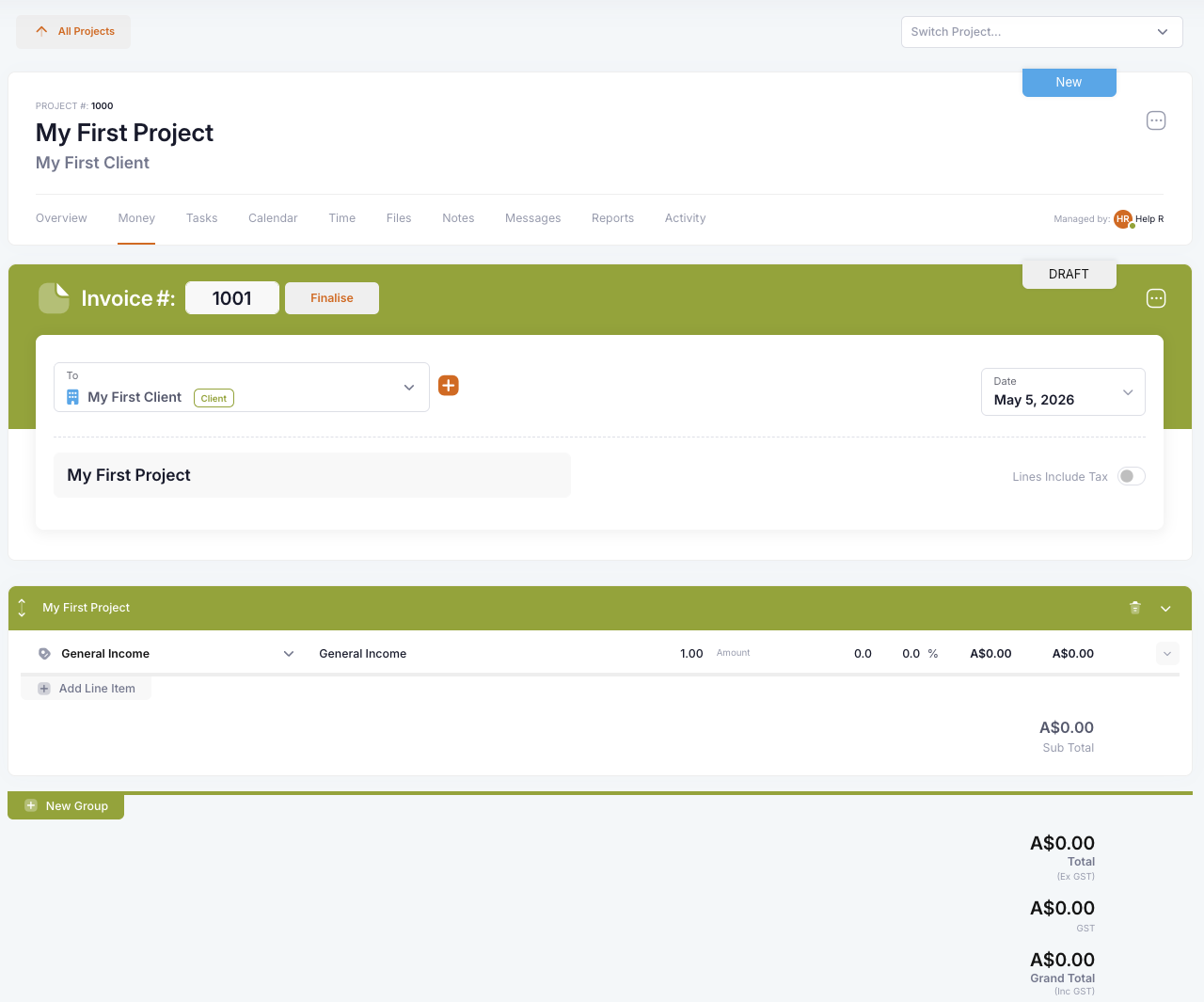
Invoices use a two-level structure for line items: Transaction Groups contain one or more Transactions (individual line items).
Transaction Groups
A transaction group is a section heading that organises related line items. For example, you might have groups called "Design Services", "Development", and "Hosting".
- Each group has a name and a position (display order)
- Groups can be reordered via drag-and-drop
- Each group shows a subtotal of its line items
Individual Line Items (Transactions)
Each line item within a group has:
| Field | Description |
|---|---|
| Product / Service | The item selected from your Products & Services list |
| Description | What the line item is for |
| Quantity | Number of units (defaults to 1) |
| Amount | Unit price |
| Adjustment % | Optional discount or markup applied to the line |
| Final Amount | Amount after any adjustment |
| Total | Quantity multiplied by the final amount |
| Account | The income account category for this line item, visible in the expanded details |
| Tax: | Tax rate to apply, visible in the expanded details |
Use Adjustment % for line-level discounts or markups. A negative value creates a discount and a positive value creates a markup.
For example, a $100.00 line item with a -10% adjustment has a final amount of $90.00. If Show Discounts & Markups is turned on in Account Settings, exported invoices and quotes show the original $100.00 amount, the -10% adjustment, and the final $90.00 amount. If it is turned off, the export only shows the final $90.00 amount.
Tax Calculation
Beeswax supports two tax modes:
- Tax Exclusive — Line item amounts do not include tax. Tax is calculated on top and added to the total.
- Lines Include Tax on — Line item amounts already include tax. Tax is calculated as a portion of the amount.
Toggle Lines Include Tax on the invoice to switch modes. This affects all line items.
System Transactions
When an invoice is saved, the system automatically creates accounting entries:
- Trade Debtors — An asset entry recording the amount owed to you
- Tax Collected — A liability entry for tax collected on the invoice
These system transactions are hidden from the invoice display but appear in your accounting ledger.
Invoice States & Workflow
Invoices move through a series of states as they progress from creation to payment.
| State | Description |
|---|---|
| Draft | New invoice. Fully editable. Not yet in the accounting ledger. |
| Finalised | Assigned an invoice number and entered into the accounting ledger. Sending and payment options become available. |
| PDF Sent | PDF has been emailed to the client. |
| Marked Sent | Manually marked as sent (without emailing). |
| First Notice | First payment reminder has been sent. |
| Second Notice | Second payment reminder has been sent. |
| Final Notice | Final payment reminder has been sent. |
| Partial Paid | One or more payments received, but balance remains. |
| Paid | Fully paid. Invoice is complete. |
| Voided | Retired without payment. Keeps its number, line items and history, but is removed from the ledger, tax reporting and your receivables, and voided in Xero. Locked. |
Key Rules
- Line items become non-editable once a payment has been recorded (Partial Paid or Paid state)
- Users with the Manager role cannot change the Account or Tax: fields on line items — these are set by the transaction template and can only be modified by Owner, Super Admin, or Accountant roles
- Payment states (Partial Paid, Paid) are automatically set when payments are recorded
- The notice states (First, Second, Final) are set when you send follow-up emails
Finalising an Invoice
Finalising locks an invoice and prepares it for sending and payment.
What Happens When You Finalise
- The invoice is assigned a sequential invoice number (if not already set)
- The invoice date is set (defaults to today if not provided)
- The invoice enters your accounting ledger (system transactions for Trade Debtors and Tax Collected are created)
- Sending and payment options become available
Requirements
- The invoice total must be zero or positive (non-negative)
- The project must not be locked
- The invoice must be in Draft state
- The invoice date must be after your account's lock date, if one is set (see Ledger → Account Lock Date)
Correcting a Finalised Invoice
A finalised invoice never goes back to Draft. Its number is already issued and, if you are connected to Xero, it has already been sent across.
- Unpaid — just edit it. Header fields and line items stay editable until a payment is recorded; the ledger and Xero pick up the change.
- Should not exist — void it. A voided invoice keeps its number, line items and history so your audit trail is intact, but it leaves the ledger, tax reporting and receivables, and is voided in Xero on the next sync. Voiding is refused once any payment is recorded — remove the payments first. Void is in the invoice's document menu, alongside Delete; the API exposes the same action.
- Draft — delete it. Only Draft invoices can be deleted; a finalised one is voided instead.
Version History
Every invoice keeps a history of whole-document snapshots: one per editing session in the web app, one per change made through the API, and one on every state change (finalised, voided, paid). Identical content is never stored twice. While the invoice is still editable, any version can be restored — the invoice is rewritten to match it and the restore is recorded as the next version, so nothing is ever lost. Paid, voided and lock-dated invoices keep their history but cannot be restored. Each version shows what changed since the one before it: header fields, the state, and lines added, changed or removed, so you can see at a glance why a version exists. Open Version History from the invoice's document menu to browse versions and restore one; the API and the Claude connector expose the same history.
Through the API
With an invoices:write token you can create an invoice (it lands as a draft), edit it, finalise it, void it, and restore an earlier version; with payments:write you can apply and remove payments against it. See the API Tokens help page.
Attachments Through the API
With the invoice's :write scope, files can be attached to a invoice through the API or the Claude connector — as a normal file upload, or inline as base64 for assistants that cannot send files. They appear in the invoice's Files panel exactly like a web upload, count towards the account's storage, and, for an expense already in Xero, are pushed to Xero on the next attachment sync. A voided invoice does not take attachments.
Sending & Emailing
Once finalised, you can send the invoice PDF to your client.
Email PDF
From the menu select Send and then click on the Email PDF
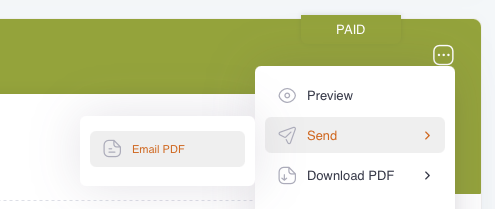
Enter recipient email addresses (TO field)
Optionally add CC recipients
Write a custom message to include in the email
Preview the PDF before sending
Click Send
The system attaches the invoice PDF and delivers it to all recipients. Any contacts who are flagged as accounts will have their email address already populated in the email field.
If the invoice's Online Payment switch is on and Stripe is connected, the email also includes a Review and pay button so your client can pay by card. The send window tells you whether a payment link will be included. See the Online Invoice Payments help article for setup.
Mark as Sent
If you deliver the invoice outside of Beeswax (e.g. printed or sent via another tool), you can manually mark it as sent:
- Click Mark as Sent from the Send menu
- This updates the state without sending an email
- You can remove the sent status later if needed
Payment Reminder Notices
Invoices support First Notice, Second Notice, and Final Notice states for tracking payment follow-ups:
- First Notice — First payment reminder
- Second Notice — Second reminder
- Final Notice — Final demand for payment
Re-sending the PDF from a notice state advances the invoice to the next notice level.
PDF Layout Options
When downloading or emailing the PDF, you can choose from several layouts:
| Layout | Description |
|---|---|
| Everything | Full detail — all line items, quantities, amounts, and tax |
| No Line Item Details | Hides individual transaction descriptions |
| No Line Qty or Amounts | Shows line items but hides quantity and unit price columns |
| Total with Details | Shows the total with supporting detail |
| Total without Details | Shows only the invoice total |
Payments & Remittances
Payments against invoices are tracked through remittances.
Recording a Payment
Each payment (remittance) records:
| Field | Required | Description |
|---|---|---|
| Amount | Yes | The payment amount |
| Date | Yes | When the payment was received |
| Bank Account | Yes | Which bank account received the payment |
How Payments Work
- When you record a payment, the system creates an IncomePayment journal entry for accounting
- The invoice's payable amount decreases by the payment amount
- The invoice's paid amount increases accordingly
Payment States
- If the payment equals the remaining balance → invoice moves to Paid
- If the payment is less than the remaining balance → invoice moves to Partial Paid
- If a payment is deleted and no payments remain → invoice reverts to Finalised
Online Card Payments
If Online Invoice Payments is set up, clients can pay straight from the invoice email and Beeswax records the payment automatically — into the bank account you chose when connecting Stripe, moving the invoice to Paid or Partial Paid just like a manual payment. See the Online Invoice Payments help article.
Important Notes
- You cannot delete an invoice that has payments recorded against it
- Payments can be linked to bank statement line items for reconciliation
- Users with the Manager role cannot approve payments — only Owner, Super Admin, and Accountant can
Refunding a Customer
If you need to return money to a customer for a paid invoice — an overcharge, cancelled work, a billing error — record it as a Customer Refund rather than editing the invoice.
- Open the paid (or partially paid) invoice
- Click the menu (⋯) in the document header and choose Refund Customer
- Confirm — a draft Customer Refund is created, prefilled from the invoice
- Adjust the line amounts for a partial refund, then Finalise
- When you've transferred the money back, click Record Money Paid in the refund's Payments section
The invoice then shows a "Refunded $X of $Y" note in its Payments section linking to the refund. The refund reduces the same income categories the original used, and reduces the GST on sales in your tax report.
See the Refunds help article for full details.
Recurring Invoices
Recurring invoices allow you to automatically generate invoices on a monthly schedule.
Setting Up a Recurring Invoice
- Create and finalise the template invoice with your standard line items
- Click Schedule from the invoice menu
- Configure the recurring settings:
| Setting | Description |
|---|---|
| Start Date | When to begin generating invoices |
| End Date | When to stop (leave empty for indefinite) |
| Recipients | Select contacts to receive the auto-generated invoice via email |
How It Works
- The system generates a new invoice on the same day each month (based on the template invoice's date)
- The generated invoice title includes the billing period (e.g. "Invoice [13 Jan - 12 Feb 2026]" or "Invoice [Feb 2026]")
- Each generated invoice is automatically finalised
- If recipients are configured, the PDF is emailed automatically
- Generated invoices are flagged as auto-generated and linked back to the source template
Month Boundary Handling
If the template invoice date is the 29th, 30th, or 31st, the system adjusts for shorter months (e.g. February uses the 28th).
Managing Recurring Invoices
- You can view all active recurring invoices from the Recurring Invoices page
- Edit the start/end dates or recipients at any time
- Deactivate a recurring invoice to stop future generation
- The system automatically deactivates when the end date is reached and sends a notification
Important Notes
- Recurring invoices are monthly only — no weekly or quarterly option
- Only available for invoices (not expenses or quotes)
- Users with the Manager role cannot manage recurring invoices — only Owner, Super Admin, and Accountant can
Templates & Duplication
Save as Template
Any invoice can be saved as a template for reuse:
- Open the invoice menu and select Templates > Save as Template
- The invoice is copied to your account's template library
- Templates preserve line items, tax settings, and account defaults
Import from Template
After creating a draft invoice:
- Open the invoice menu and select Templates > Import Template
- The new invoice is pre-populated with the template's line items and settings
- You can then modify any fields before saving
Duplicate
To create a copy of an existing invoice:
- Click the invoice menu and select Duplicate
- A new draft invoice is created with all the same details
- The duplicate gets a new sequential number and today's date
Note: The Online Payment setting carries over to duplicates, but each invoice gets its own unique payment link.
Converting from Quote
Quotes can be converted into invoices.
How to Convert
- Open the quote
- Click Make Invoice from the quote menu
- Confirm the conversion
What Happens
- A new invoice is created as a deep copy of the quote
- All transaction groups and line items are copied
- The company, project, and content are preserved
- The new invoice gets a fresh invoice number and today's date
- The invoice starts in Draft state
- The original quote remains unchanged
Important Notes
- Quotes can be converted from any state — finalisation is not required
- You can convert the same quote to an invoice multiple times
- Each conversion creates a separate, independent invoice
- An activity log entry records the conversion
Import & Export
Importing Invoices
You can bulk-import invoices from a CSV file:
- Click Import from the invoices list
- Upload a CSV file
- The system recognises "Sale Order" and "Tax Invoice" rows as invoices
- Imported invoices include the invoice number, line items, and amounts
PDF Export
Download any finalised invoice as a PDF:
- Open the invoice menu and select Download PDF
- Select a layout option such as Everything, No Line Item Details, No Line Qty or Amounts, Total with Details, or Total without Details
- The PDF is generated and downloaded
Xero Integration
If your account is connected to Xero:
- Invoices can be synced to Xero automatically
- The system tracks sync status and prevents duplicate syncing
- Payment updates from Xero webhooks are detected to avoid sync loops
How-to Guides
Create an Invoice
- Open the project you want to invoice.
- Select the Money tab, then open Invoices.
- Click New Invoice.
- Beeswax creates a Draft invoice and opens it.
- Confirm the To, Date, and Enter a Title fields.
- Use Lines Include Tax if your line item amounts already include GST/VAT.
- Use the existing Group Name field, or click New Group to add another section.
- Click Add Line Item inside the group.
- Choose the product/service, then enter the description, quantity, amount, and any adjustment.
- Open the line item arrow when you need to check Account or Tax:.
- Review totals, then click Finalise when the invoice is ready to lock for sending and payment.
Note: Groups organise invoice sections and show subtotals. They do not create milestones.
Edit an Invoice
- Open the invoice from the invoice list, Money Search, or the project
- Click fields to modify — changes save automatically
- Use the arrow at the end of a line item to expand Account, Tax:, and line item notes
- Open the invoice menu and select Preview when you want to check the PDF
Delete an Invoice
- Locate the Invoice
- Open the invoice menu and select Delete
- Confirm deletion
Note: Invoices with payments applied cannot be deleted. Remove the payment first (you may need to unreconcile the payment before removing it).
Preview an Invoice
- Find the invoice
- Open the invoice menu and select Preview
- Choose a display option such as Everything, No Line Item Details, No Line Qty or Amounts, Total with Details, or Total without Details
Schedule an Invoice
- Open an existing finalised invoice, or create and Finalise a new one
- Open the invoice menu and select Schedule
- Set scheduling preferences and save
Note: The stop-after date is a future cutoff. The scheduled range displays in the invoice title.
Duplicate an Invoice
- Locate the Invoice (via Global Search, Money Search, or Project)
- Open the invoice menu and select Duplicate
Create an Invoice from a Quote
- Navigate to the Project with the Quote
- Open the quote
- Open the quote menu and select Make Invoice
- The system transfers all Quote information into a new Invoice (Draft status)
- Make adjustments and finalise
Apply a Payment
- In Who Owes Me, select the invoice checkbox
- Click Apply Payment — the full amount auto-populates (adjust for partial payments)
- Click Save
Invoice Creation Methods
Invoices can be created in several ways:
- Manual — Create from scratch within a project
- From Time Entries — Import completed time entries as line items
- From Template — Create a draft invoice, then use Templates > Import Template to pre-populate line items
- Duplicated — Clone an existing invoice
- From Quote — Convert a quote into an invoice
Invoice States
| State | Description |
|---|---|
| Draft | Editable, not yet in the accounting ledger |
| Finalised | Gets an invoice ID, payment is allowed, enters the accrual ledger |
| PDF Sent | PDF has been emailed to the client |
| Marked Sent | Manually marked as sent without emailing |
| First Notice | First payment reminder has been sent |
| Second Notice | Second payment reminder has been sent |
| Final Notice | Final payment reminder has been sent |
| Partial Paid | One or more payments received, balance remains |
| Paid | Fully paid, invoice is complete |
Permissions by Role
Different roles have different levels of access to invoice features.
| Action | Owner | Super Admin | Manager | Accountant | Basic | Client |
|---|---|---|---|---|---|---|
| View invoices | All | All | All | All | No | No |
| Create invoices | Yes | Yes | Yes | Yes | No | No |
| Edit invoices | All | All | All | All | No | No |
| Edit line item account/tax | Yes | Yes | No | Yes | No | No |
| Finalise invoices | Yes | Yes | Yes | Yes | No | No |
| Send/Email PDF | Yes | Yes | Yes | Yes | No | No |
| Record payments | Yes | Yes | Yes | Yes | No | No |
| Manage recurring | Yes | Yes | No | Yes | No | No |
| Delete invoices | Yes | Yes | Yes | Yes | No | No |
| Import invoices | Yes | Yes | Yes | Yes | No | No |
| View own statements | — | — | — | — | No | Yes |
Key Notes
- Owner and Super Admin have full access to all invoice operations.
- Manager can manage invoices but cannot approve payments, manage recurring invoices, or change line item account/tax fields (these are set by the transaction template).
- Accountant has full access to financial features but cannot approve payments or manage account settings.
- Basic users cannot view or manage invoices. They do not have access to financial documents.
- Clients cannot view individual invoices. They can only see outstanding statements for their own business via the Statements feature.
- Contractors have limited access focused on task management rather than financial documents.
- Invoices in a locked project cannot be created or modified.